 CPS Resource Centre
 Membership dues – a big thank you from the CPS
Spanish Post recently issued two commemorative issues of high cartophilatelic importance. On each issue the ‘ñ’ symbol represents the domestic postal‑service denomination, while the 3€ price the fixed face value of the commemorative stamp (Efemérides) and does not correspond to the domestic postal rate, in our understanding.
 |
|
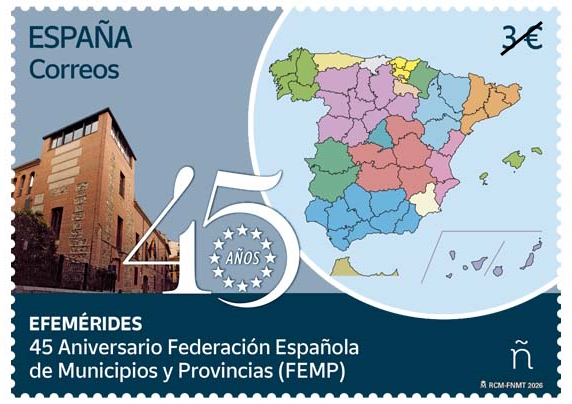
Spanish Post, 2026-03-27 — 45th anniversary of the |
The March 27, 2026, issue marks the 45th anniversary of the founding of the Federación Española de Municipios y Provincias (FEMP) — the national association representing Spain’s local governments. Founded on June 14, 1981 by a group of 20 mayors who sought to create a unified national body for Spanish local governments. Today, the FEMP includes 95% of Spain’s municipalities, plus provincial and island councils. The 58mm x 41mm stamp features a colorful thematic map of Spain’s autonomous provinces, island councils and autonomous cities. Also visible is a portion of the north coast of Africa. While not visible on the current image one assumes that the autonomous areas of both Ceuta and Melilla are shown on the stamp. In the lower right of the map is an inset showing the two provinces of the Canary Islands: the four islands of Santa Cruz de Tenerife (left) and the three islands of Las Palmas (right). On the left side of the stamp is an image of the façade of the FEMP headquarters in Madrid.
On April 1, 2026, Spanish Post issued stamp commemorating the Centenary of the Madrid–Manila Aerial Expedition, 1926.
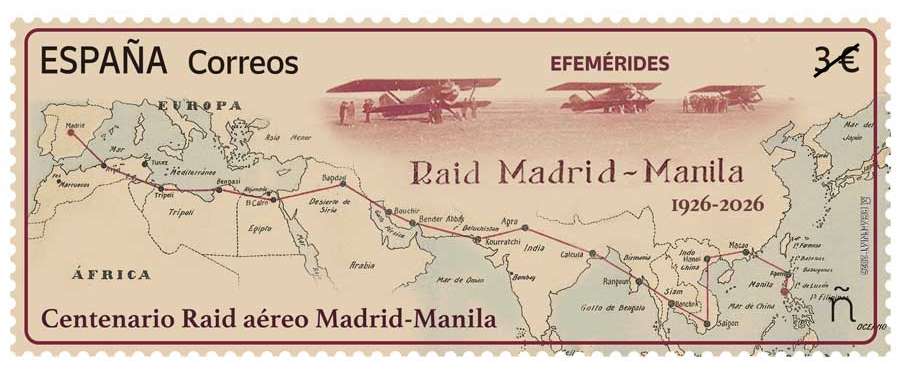 |
| Spanish Post, 2026-04-01 – Centenary of the Madrid–Manila Aerial Expedition, 1926-2026 |
In 1924, Spanish military aviators proposed an ambitious aerial expedition to the Philippines to showcase Spain’s aeronautical progress. Delayed until 1926 due to late aircraft deliveries, the mission—named the “Elcano Squadron” in honor of Juan Sebastián Elcano — departed Madrid with three Breguet XIX biplanes. After numerous difficulties, only one aircraft, the “López de Legazpi,” successfully reached Manila on May 13, 1926, completing the 17,000‑kilometer journey over 39 days and more than 106 hours of flight. The aviators carried official messages and private correspondence along the route. Upon arrival, Manila applied two special commemorative hand‑stamped markings to the transported mail, prepared specifically for the occasion and certified by the local postal authorities.
The horizontal layout is approximately 75 mm x 29 mm and primarily features a map depicting the route the expedition flight traveled from Madrid to Manila. The map shows the then-existing boundaries of the countries transited and major waypoints along the route. In the upper right of the stamp is a stylized vignette of the three aircraft on the landing strip.
Asking Microsoft Copilot to describe the stamp image resulted in this well-written bit of copy, “The stamp is rendered in a warm, sepia‑toned palette of ochres, rust reds, and parchment creams, giving it the feel of an aged flight log or expedition map. A bold, stylized map dominates the composition, its simplified landmasses and thick route line recalling early air‑navigation charts. In the upper right, a soft vignette of three ghosted aircraft drifts across the background, their translucent forms evoking archival photographs. The layered, poster‑like design blends vintage aviation aesthetics with modern graphic clarity, creating a commemorative piece that feels both historical and contemporary.”

